Unidirectional workflow
Can PCR amplicons really cause contamination?
A: YES, PCR amplicons pose a significant risk to continuity of Newborn Screening. All staff must be trained prior to working in the laboratory. PCR amplification is an exponential reaction where a DNA target of interest is doubled every PCR cycle. After 30 cycles of PCR, a single DNA fragment could produce approximately 1 billion PCR amplicons (230 copies). Amplified DNA fragments are easily aerosolized, as droplets can be scattered each time a tube or cap is opened from an amplified product or when the amplified product is pipetted. These aerosolized amplification microdroplets can move through the air, on dust particles or can be transferred via gloves, pipettors, etc. and deposited on laboratory surfaces
1,2.
How can potential amplicon contamination be mitigated?
A: PCR generates amplified DNA that can contaminate other samples, reactions or surfaces, and PCR reactions can be contaminated by other DNA sources. The contamination from previously amplified targets or from patient samples may go unnoticed and could result in incorrect test results including false negatives, leading to the need for extensive lab cleanup and possible temporary lab shut down.
Laboratories performing molecular assays should institute procedures to reduce the risk of cross contamination of test samples with amplified DNA products.
Possible Mitigations for potential amplicon contamination include:
- Unidirectional laboratory workflow
- Operator training and following good laboratory practices
- Use of disposable materials (e.g. gloves, lab coats, consumables)
- Use of DNA-free and nuclease-free water
- Frequent changes of gloves and other PPE
- Placement of a sticky or tacky mat at the entrance of the Pre-PCR and Reagent Rooms
- All staff that enters the laboratory should wear a lab coat appropriate for the room (this includes administrative staff, facilities maintenance, vendors as well as laboratory staff)
- Decontamination of instruments (liquid handlers and centrifuges) after a spill and/or routine cleaning and decontamination, based on laboratory’s Standard Operating Procedure
- Positive displacement pipettes or filter tips for reaction set up
- Aliquoting bulk PCR reagents (e.g. Enzyme master mix and water) into small volume single use working stocks
- Separation of dedicated equipment and materials including PPE, for use only in pre-amplification laboratory spaces2.
- Inclusion of negative controls, such as no-template controls, water blank controls, and normal controls on all PCR plates as indicators of potential contamination.
What is Unidirectional workflow and how does this affect my laboratory?
A: Unidirectional workflow in the molecular laboratory is based on a combination of laboratory practices and laboratory design (i.e. engineering controls) that are used to reduce the risk of sample contamination.
Careful consideration should be given to facility design and operation within laboratories in which PCR is performed.
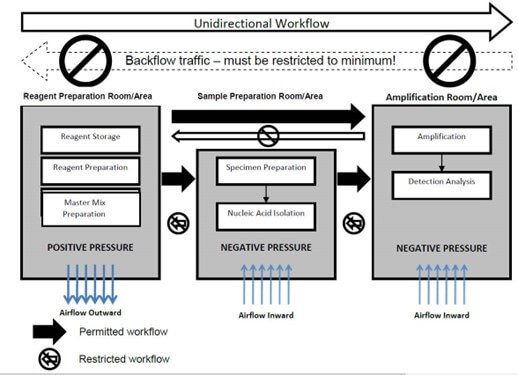
Good laboratory practices for molecular testing require a unidirectional workflow that separates all Pre-PCR assay stages from all PCR amplification and Post-PCR stages. These procedures include a physical separation of the different stages of the procedure, dedicated equipment and supplies for stages, and a unidirectional workflow such that specimens or testing personnel do not enter Pre-PCR workspaces after possible exposure to amplified products without suitable precautions. Ideally, at least three separate enclosed rooms should be utilized. These include a room for: 1) reagent storage and preparation, 2) a room for sample preparation, DNA extraction and assay set-up, and 3) a room for PCR amplification and post-amplification sample manipulation. The rooms for reagent storage and preparation and for sample preparation, DNA extraction and assay set up are often referred to as “Clean” rooms and the room for PCR amplification and post-amplification sample manipulation is often referred to as “Dirty” room(s).
Unidirectional Workflow Diagram1

Why do I need to use positive displacement pipettes or filter pipette tips?
A: Aerosolized amplification microdroplets can be easily transferred onto pipettors if a barrier is not in place to prevent this contamination. When dispensing sample or reagent, the aerosolized amplification microdroplets can then be further transferred from the pipettor to the sample or reaction. A positive displacement pipettor has no air between the piston and the reagents, which limits the risk of aerosol contamination. A pipette tip with a filter provides a barrier between the pipettes and the liquid aspirated, preventing the transfer of aerosols into samples and reagents.[3]
What happens in a Reagent Preparation Room?
A: A DNA-free clean reagent preparation room should be dedicated solely to the storage and preparation of PCR reagents. Activities in a reagent preparation room include aliquoting or diluting primers, and preparing PCR cocktails with probes, dNTPs, and polymerase. DNA, including blood and isolated DNA specimens, PCR products, or plasmids, should never be introduced into the Reagent Preparation Room. Cocktails are prepared in the Reagent Preparation Room and then transferred to a Pre-PCR/Sample Preparation Room for DNA addition. All equipment, reagents, consumables, and PPE such as lab coats should be dedicated specifically to this room only. Items that have previously been in another room or laboratory should be thoroughly cleaned (See section 6, below) to remove any contaminants prior to entry into this room. In addition, any clothing or personal accessories (e.g., jewelry, cell phones, ear buds) that may have been near amplicons from the Post-PCR Room or samples from the sample preparation room should not enter the reagent room. Long hair should be tied back to avoid carrying amplicons among rooms.
If a laboratory is unable to dedicate a room specifically for reagent preparation, a circulation-free enclosure (i.e. Dead Air Box) can be used, if physically separated as far as possible from the Post-PCR area. The reagent prep area and Dead Air Box should still include dedicated instruments, consumables, etc., as described above.1,2
What happens in a Pre-PCR or Sample Preparation Room?
A: The Pre-PCR or Sample Preparation Room/Area is used for specimen accessioning, sample preparation, and nucleic acid extraction. Additionally, the final step of PCR reaction set-up is carried out in the Sample Preparation Room or work area, in which the PCR cocktail, including master mix, primers, probes and other reagents, are brought from the Reagent Preparation room into the Sample Preparation Room, and the DNA is added to the cocktail. If plasmids are used as calibrators for use in standard curves, or similar, they must be diluted to working stocks in a separate designated space (i.e a Dead Air Box) for plasmids before being brought into the Sample Preparation Room.
Do not bring stock or concentrated plasmid into the Sample or Reagent Preparation Room. If there is no designated space, consider diluting the working stock in the Post-PCR Room and wiping the tube exterior with a decontamination solution, such as 10% household bleach or DNA-Away®, prior to bringing into the Sample Preparation Room. Small batches of working stock could be prepared and aliquoted into single-use tubes in the Post-PCR Room and stored in a freezer in the Post-PCR space for the short term (up to 1 month). All pipets, instruments and consumables should be dedicated to this room.1
What happens in an Amplification/Post-PCR Room?
A: The room for PCR amplification and amplified product/amplicon processing, often called the Post-PCR Room, is used for sample amplification and all steps that occur after the amplification process. Surfaces and samples in rooms with amplified DNA are highly susceptible to contamination. Instruments in this room typically include PCR thermocyclers, real-time PCR instruments, genotyping instruments such as Bead-Array detectors or PCR-ELISA systems, and other sequencing instruments. Procedures that occur in this room may include PCR, genotyping, sequencing (Sanger and next-generation sequencing [NGS]), gel electrophoresis, and PCR cleanup.1 Amplification products (gels and tubes or plates containing amplicons) should be stored or disposed of in this room and should not leave this room. PPE used in this room should be stored or disposed of in this room and should not be worn into other areas.
Where should plasmids stocks be diluted?
A: Highly concentrated plasmids should be treated as amplified DNA. Do not bring the tube(s) of these highly concentrated plasmids into a Pre-PCR or Reagent Room. If plasmids are used as calibrators for use in standard curves, or similar, they should be diluted to working stocks in a separate designated space for plasmids. Neither concentrated plasmid stocks nor diluted working stocks of plasmids should ever be brought into the Reagent Room. For extra caution, it is recommended to bring the diluted plasmid into the Sample Preparation Room for reaction assembly. If the diluted plasmid is brought into the Pre-PCR room, wipe the tube exterior with 10% household bleach or DNA-Away® prior to bringing into the Sample Preparation Room.
How do I clean item(s) that need to go against the unidirectional workflow (from Post-PCR to Pre-PCR or reagent room).
A: When possible, items should be dedicated to a specific room. However, in some cases, an instrument or piece of equipment may need to be moved against unidirectional workflow.
To decontaminate, soak the item in a 10% household bleach solution followed by a water rinse; if the item or piece of equipment cannot be submerged, wipe the items thoroughly with a 10% household bleach solution followed by wiping with water. Supplies and consumables that are difficult to clean, such as items with porous surfaces, paper items, etc., should not be moved against the unidirectional workflow. For supplies that are common to both Pre-PCR and Post-PCR laboratories, store items only in the Pre-PCR laboratory or non-laboratory storage room and transfer to Post-PCR laboratory space as needed.
Note: Prior to using bleach solutions, be aware of potential negative impacts to mass spec or other assays.
Can I share supplies between laboratory spaces?
A: Each laboratory space - Reagent Prep, Pre-PCR and Post-PCR - should have dedicated instruments, PPE, consumables, and reagents. If reagents must be shared, place stock aliquots in a storage or general location. Aliquots can then be removed and dedicated to the specified laboratory room/space as “working stocks” as needed. If supplies or consumables must be shared, place items in a storage or general location. As consumables are needed, items can be removed and dedicated to the specified laboratory room/space as needed. Avoid transfer of any supplies, consumables, or PPE from Post-PCR spaces into Pre-PCR spaces if possible, especially those that are difficult to clean such as items with porous surfaces, paper items, etc.
How do I monitor for contamination in my laboratory and what do I do if contamination is detected?
A: Inclusion of a no template control on each reaction plate for all assays can help indicate that a contamination event has happened. This reaction has all primers and reagents found in the other reactions on the plate but template DNA is not added. This reaction should ideally show no amplification. Amplification in the no template control indicates a possible contamination, potentially within the assay reagents, during set up of the assay (cross-contamination), or via environmental contamination from aerosolized product within the room.
One method to test for contamination of laboratory surfaces is to perform routine environmental wipe tests. During a wipe test, cotton swabs, or similar, are rubbed along several areas within the lab. Any DNA on the swab is eluted off and the sample is tested for the presence of DNA by running it with the assays used in the laboratory. Lack of amplification indicates that there is no detectable contamination for the amplicon tested.
If a contamination is suspected to be in reagents, these reagents and their derivatives should be thrown out. If a contamination is suspected to be in a work area, replace all disposable supplies and decontaminate the surface areas and equipment. All previously used PPE in the room must be replaced. For reusable supplies, when possible, soak the items in a 10% household bleach solution or DNA-Away® followed by a water rinse; if the item or piece of equipment cannot be submerged, wipe the items thoroughly with a 10% household bleach solution followed by wiping with water.
If an amplicon contamination is found, consider having staff decontaminate the room and/or area that do not work with the assay. This will ensure that the room is not further contaminated during the decontamination process.
Note: A library of all DNA amplicons and their location of use within the laboratory may provide a method to track the source of the contamination.
Planning a Laboratory Layout
What should be considered when expanding the lab or repurposing the lab’s current layout for better workflow?
A: Considerations include:
- How can I ensure unidirectional workflows while optimizing use of available space, entry and exit doors and walking patterns between areas?
- Do I have enclosed rooms that can be dedicated and equipped for specific tasks (i.e. Post-PCR, Pre-PCR and Reagent Preparation)?
- Does the room that I’m considering for the Post-PCR room have the capacity to hold all instruments and workstations that will be needed?
- Can I segregate similar molecular functions together and away from others (e.g., assays and instruments with sealed plates vs assays that require pipetting of amplified product)?
- What types of assays are currently (or projected to be) performed in my laboratory that require designated workflows or special considerations such as a unidirectional workflow? What steps are involved in each assay?
- When repurposing, what was the space previously used for and what needs to be done to ensure the space has been properly decontaminated (see question below on "How do I convert a room that has been used for Post-PCR use into a Pre-PCR Reagent Room or Pre-PCR Sample Preparation Room?")
What do I do if I don’t have a separate room/laboratory for reagent preparation?
A: If a separate reagent prep room is not available, Dead Air Boxes or PCR workstations are recommended. Preparation of all PCR cocktails and primer dilutions should occur in the Dead Air Box. All equipment including pipettors, tips, gloves, PPE, vortex, bench-top centrifuges, etc., should be dedicated to reagent preparation and remain in that designated area. This reagent preparation area should be located in areas of limited traffic to minimize risk from air currents created by other laboratory personnel. If possible, check the direction of airflow within the lab to maintain positive pressure, and consider the impact of entry and exits. The PCR workstation for reagent preparation should be placed up-wind. Dead Air Boxes or PCR workstations dedicated to reagent prep should not be used for sample prep or for any Post-PCR work.
What is positive or negative air pressure? What does this mean in a molecular laboratory?
A: In a room with positive pressure, the air pressure is adjusted to be higher in the room than outside the room. This positive pressure forces air to flow from the room to help prevent amplified material in air currents as aerosols or on dust particles from entering the pre-amplification laboratory.
Reagent preparation rooms should have positive air pressure to reduce the risk of environmental contamination.
Conversely, a room with negative air pressure has a higher pressure outside the room than inside the room. This allows the air to circulate from outside of the room into the room through the air handling system.
Where possible, it is recommended that sample processing and Post-PCR rooms may have negative air pressure, as this keeps potentially contaminated air contained within the room and unable to flow outside into hallways or other rooms1.
Due to building construction, the airflow in some buildings must go in only one direction (positive or negative). In these situations, it is recommended that air flow is with positive pressure, which keeps potential contaminated amplicons from blowing into each room where reagents are stored and prepared. Facility maintenance or safety offices may be able to help identify the air flow in laboratories.
What are the standards for the air pressure values in a laboratory?
A: Air pressure in reagent preparation rooms should have “slight positive air pressure compared to air in a connecting hallway” and sample preparation rooms and Post-PCR rooms should have “slightly reduced pressure to pull air in from the outside”.1 Air lock doors are also recommended for each of these rooms, if possible.1For laboratories without an air pressure indicator, a simple method to monitor positive or negative air pressure is to determine airflow direction by placing a piece of tissue paper over a gap in the door. If the tissue paper is blown into the hallway, the room has positive pressure. Conversely, if the tissue paper is blown into the room, it is under negative pressure.
What do I do if my lab is open-concept and we don’t have separate rooms for Pre-PCR and Post-PCR?
A: When it is not possible to have a dedicated Pre-PCR and Post-PCR Room, a physical separation of these spaces should occur. This physical separation may be divided as opposite ends of a large open laboratory, in addition to including Dead Air Boxes or PCR workstations. Workspaces, instruments, PPE, and consumables should be dedicated for these tasks. It is important to change PPE when working between Pre-PCR and Post-PCR areas in the same room. One easy way to identify PPE that is specific for Pre- or Post-PCR is to use is color-coded PPE for each area. For example, pink gowns and purple gloves can be used for Pre-PCR and blue gowns and blue gloves can be used for Post-PCR.
Which of these recommended rooms should be the largest?
A: Room size will depend on the activities that will occur in each room and the number of staff assigned to each of these activities. Generally, the Pre-PCR room will need the largest workspace, as this is where sample accessioning, DNA extraction and PCR set up occur. The reagent preparation room is often the smallest space, as its function is only for personnel to prepare reagents. The amount of laboratory space needed in the Post-PCR laboratory is typically dependent on the number of thermal cyclers and other instruments in that room as well as the type of workflows needed. When setting up laboratory space, consider further dedicating space in the Post-PCR room to closed systems which do not require further handling of amplified PCR products (e.g., real-time instruments) and a second area for open systems which do require pipetting of amplified material (NGS, Sanger sequencing, gel electrophoresis).
How do I convert a room that has been used for Post-PCR use into a Pre-PCR Reagent Room or Pre-PCR Sample Preparation Room?
A: All surfaces in the room will need to be thoroughly cleaned and decontaminated to remove all traces of any amplified DNA products. All laboratory surfaces, including benches, shelves, walls, floors, and ceilings, will need to be wiped down with a 10% household bleach solution to destroy any residual DNA. Following the bleach treatment, all surfaces should be rinsed with water to remove bleach residue. When able, consider replacing porous surfaces, such as ceiling tiles and cork boards.
Are there pointers or suggestions that my lab can employ to help lab staff follow or maintain unidirectional workflow?
A: A few methods employed by NBS labs include:
- designating lines of entry and exit doors
- designating walking routes within the lab
- designating different colored lab coats for each of the lab areas
- establishing a schedule of designated staff to conduct procedures (e.g., a staff member might be assigned to work in the Pre-PCR area, while another works in a Post-PCR area for a selected time period.)
Dead Air Box
What is a Dead Air Box (DAB) and how do I use this? What can I store in a DAB?
A: A Dead Air Box is an enclosed space that minimizes air circulation to help prevent cross-contamination. They are often used for reagent preparation and for PCR set up. Each Dead Air Box should have dedicated supplies (e.g., consumables, tip boxes and pipettors) that are not shared with other laboratory bench areas or other DABs even in the same workspace. The DAB should be decontaminated with a 10% bleach solution and then a 70% ethanol rinse after each use. Units may also have a UV light and timer for additional decontamination.
Where do I put a Dead Air Box that will be used for reagent or sample preparation?
A: The Dead Air Box should be placed as far away from the Post-PCR area of the lab as possible. It should also be placed away from high traffic areas. Check laboratory air flow direction and locate the Dead Air Box away from any strong air currents within the room. Facility maintenance or safety offices may be able to help identify the air flow in laboratories.
What is the difference between a Dead Air Box, a Biological Safety Cabinet, and a Laminar air flow hood?
A: Dead Air Boxes are used to isolate the work area from the surrounding laboratory and minimize air flow to limit environmental contamination from airborne DNA or amplified PCR products. Many Dead Air Boxes are not ventilated and do not require filters or ventilation, so these units can be placed directly on a work bench with ease of maintenance and use.
Biological Safety Cabinets (BSCs) are typically used for work with infectious agents or tissue culture procedures. BSCs create an internal negative cabinet pressure through laminar air flow to prevent any potentially infectious material from entering the surrounding lab environment.
Laminar flow hoods similarly produce a steady flow of air within the cabinet to create either a negative pressure or positive pressure, depending on design. For a Pre-PCR laboratory, a Dead Air Box is recommended rather than a BSC or laminar flow hood, because it minimizes the risk for aerosolized particle cross contamination.
Incorporating Laboratory Assays and Workflow into Laboratory Layout
How should I include sequencing, Sanger and NGS into the laboratory workflow?
A: DNA sequencing assay workflow is complex and requires various steps to be performed in distinct sections of the molecular laboratory.
These steps can include, for example, DNA extraction in the Pre-PCR laboratory, NGS library preparation (Pre-PCR), library quality control (Post-PCR), clean up of Sanger PCR and cycle sequencing reactions (Post-PCR) loading and processing on the sequencing platform (Post-PCR). Each of these rooms should have dedicated instruments for each of the steps in the appropriate rooms. Refer to the manufacturer recommendations and kit instructions for details. Depending on the platform and the method, hazardous materials such as formamide may be used in a molecular laboratory. If so, a chemical fume hood may also be needed in the Post-PCR workspace.
How should I include real-time qPCR PCR assays in the workflow?
A: Molecular assay workflow for qPCR is similar to a standard PCR reaction. The enzyme master mix, amplification primers, and probes are stored and prepared in the Pre-PCR/Reagent Preparation room. Depending on the assay, DNA will be extracted from a dried blood spot punch or the dried blood spot punch is included directly in the amplification assay. In both cases, the extracted DNA or the DBS are added to the assay plates in the Pre-PCR room. Plates are sealed and transferred to the Post-PCR room for processing on the appropriate instrument. Choose an optical sealing film that adheres very strongly to the PCR plate to eliminate accidental spilling of Post-PCR products during disposal, as most routine real-time PCR assays do not require manipulation of Post-PCR products.
How should I include genotyping assays (Luminex, ARMS, etc.) in the workflow?
A: There are many diverse types genotyping assays with different steps. However, for each of these assays unidirectional workflows should be utilized. All aliquoting and dilution of primers, and preparation of assay reaction cocktails are prepared in the Reagent Preparation room. DNA extraction and the addition of the DNA to the reaction mixture is done in the Pre-PCR or Sample Preparation Rooms, and plates are then sealed and transferred to the Post-PCR Amplification room. All subsequent steps involving amplified DNA occur in the Post-PCR room, including processing on instruments (i.e. Allelic Discrimination assays), gel electrophoresis and PCR clean up.
Some assays including bead-based Luminex assays or sequencing require additional master mixes to be created for use in Post-PCR rooms. Generally, any primers and master mixes used for these steps are aliquoted, diluted and prepared in the Reagent Prep Room.
These cocktails are then brought into the Post-PCR room for the addition of the amplified DNA. Please note that the location for the preparation of these reagents and creation of the cocktail is dependent on the assay and your laboratory’s standard operating procedures.
Additional Resources
What additional resources can I find on laboratory layout for a molecular laboratory:
- Clinical and Laboratory Standards Institute CLSI MM19-A (2011). Establishing molecular testing in Clinical Laboratory Environments; (1st ed.).
- Mitchell P. S. et al. Nucleic Acid Amplification Methods: Laboratory Design and Operations, 2004, In “Molecular Microbiology: Diagnostic Principles and Practice, edited by D. H. Persing et al” 99. 85-93.
- Redig, J. The devil is in the details: How to setup a PCR laboratory. Bitesize Bio [Internet]. 2020, Jan 16 [cited 2022 Jul 7]. Available from:
https://bitesizebio.com/19880/the-devil-is-in-the-details-how-to-setup-a-pcr-laboratory/
- Viana, R, Wallis, C. Good clinical laboratory practice (GCLP) for molecular based tests used. Good Clinical Laboratory Practice (GCLP) for Molecular Based Tests Used in Diagnostic Laboratories. 2011. [cited 2022 Jul 7]. Available from:
https://cdn.intechopen.com/pdfs/23728/InTech-Good_clinical_laboratory_practice_gclp_for_molecular_based_tests_used_in_diagnostic_laboratories.pdf
- Aslanzadeh, J. Preventing PCR amplification carryover contamination in a clinical laboratory. Annals of Clinical & Laboratory Science. 2004. [cited 2022 Jul 7]. Available from:
http://www.annclinlabsci.org/content/34/4/389.long
- Brookman-Amissah, N. (2016, August 24). Could your PCR be affected by contamination?: IDT. [Internet]. 2016, Aug 24 [cited 2022 Jul 7]. Available from:
https://www.idtdna.com/pages/education/decoded/article/could-your-pcr-be-affected-by-contamination
Who can help me if I need help with planning a laboratory layout that incorporates molecular assays?
A: Your laboratory’s building manager or facilities management office may be able to provide guidance, with assistance from a molecular biologist. Requests for assistance can be sent to APHL’s Molecular Subcommittee, CDC’s Newborn Screening and Molecular Biology Branch, the CDC’s Molecular Assistance Program and the CDC’s Molecular Training Workshop. Contact
newborn.screening@aphl.org with requests.
Citations:
1. Molecular Laboratory Set up: Introduction, Design, Requirements, Laboratory Practices and Its Uses. universe84a. 2021, Jul 24. [cited 2022 Jul 7]. Available from:
https://universe84a.com/molecular-laboratory-set/
2. Redig, J. The devil is in the details: How to setup a PCR laboratory. Bitesize Bio [Internet]. 2020, Jan 16 [cited 2022 Jul 7]. Available from:
https://bitesizebio.com/19880/the-devil-is-in-the-details-how-to-setup-a-pcr-laboratory/
3. Brookman-Amissah, N. (2016, August 24). Could your PCR be affected by contamination?: IDT. [Internet]. 2016, Aug 24 [cited 2022 Jul 7]. Available from:
https://www.idtdna.com/pages/education/decoded/article/could-your-pcr-be-affected-by-contamination
Disclaimer: Referral to commercial products or companies in this webpage does not constitute APHL endorsement.